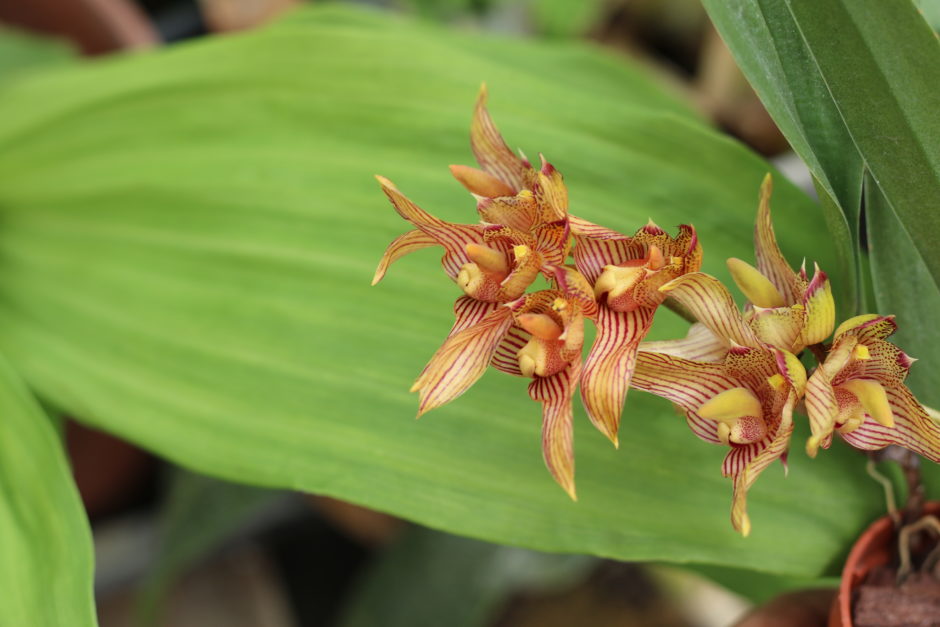
Orchids
Orchidaceae

Quick facts
| Scientific name Orchidaceae | Native to Around the world | Rainforest layer Varies depending on species |
| Size Varies from a few milimetres to a few metres | Plant family Orchidaceae | IUCN conservation status Varies for different species – learn more |
Having to Adapt
Before we became the award-winning education centre you see today, The Living Rainforest was home to one of Europe’s leading orchid nurseries: Wyld Court Orchids. Orchids have always been a big part of our story — and their story is one of remarkable adaptation and survival.
With over 28,000 known species, orchids are among the most diverse plant families in the world. Much of this diversity comes from their close relationships with other species, especially pollinators. In fact, many orchids rely on just one specific species to pollinate them. This exclusive relationship means orchids must adapt closely — and quickly — to the needs or preferences of their pollinators, leading to high rates of speciation and a dazzling variety of forms.
Depending on their environment, orchids have also adapted to live in different ways:
- Epiphytes – growing on other plants
- Lithophytes – growing on rocks
- Terrestrials – growing in soil
And yes — orchids can be found on every continent except Antarctica. That means they’re not just adapting to pollinators, but to a wide range of habitats too.
Exclusive Relationships
Like all flowering plants, orchids have one goal: to be pollinated so they can reproduce. To achieve this, they’ve evolved fascinating partnerships with specific pollinators — from invertebrates and birds to small mammals.
Each orchid species has its own preferred partner, and the success of the plant often depends entirely on that relationship.
A Sweet Reward
Some orchids offer their pollinators a treat in return for their help. One well-known example is Angraecum sesquipedale, also called Darwin’s orchid. It’s pollinated by Wallace’s sphinx moth (Xanthopan praedicta), which has a proboscis nearly a foot long — just right for reaching the deep nectar spur of the orchid.
As the moth feeds, the orchid cleverly deposits pollen onto it. The moth then carries that pollen to the next flower, unknowingly completing the orchid’s mission. You can see Angraecum sesquipedale in our Lowlands Glasshouse.

You’ve Been Fooled
Not all orchids play fair. Around one-third of known orchid species rely on deception rather than reward.
Take Paphiopedilum, also known as the slipper orchid. Its petal forms a pouch or “shoe” shape — not just for looks, but as a clever trap. While it may resemble a carnivorous plant, this orchid doesn’t want to eat the insect, only to use it.
Paphiopedilum lures in flies by mimicking the smell and appearance of decaying matter or fungi — perfect egg-laying spots for many fly species. Once inside the pouch, the fly becomes trapped. To escape, it must crawl through a narrow tunnel, brushing first against the stigma (depositing any pollen it carries) and then the anther, which gives it a fresh load of pollen to carry to the next flower.
You can find this clever little orchid in the Lowlands Glasshouse, near the entrance to the Small Islands Glasshouse.
Seeds Like Dust
Orchid seeds are some of the smallest in the plant world — so tiny that you’d need a microscope to see them properly. A single orchid seedpod can contain up to three million seeds, each no bigger than a speck of dust.
But their small size comes with a challenge: orchid seeds don’t contain any stored food (called an endosperm), which most other seeds use to help them grow. Without this food supply, orchid seeds can’t germinate on their own.
Instead, they rely on a special relationship with a type of fungus found in the soil. The fungus provides the nutrients the seed needs to start growing — a process known as mycorrhizal symbiosis. Only when the right fungus is present can the orchid seed successfully sprout and begin its life. This delicate dependency helps explain why growing orchids from seed in the wild is so difficult — and why their survival often depends on very specific conditions.
Good Enough to Eat
One of the most famous — and delicious — members of the orchid family is Vanilla planifolia, the plant behind the familiar vanilla flavouring used in everything from ice cream to cakes.
Native to Mexico and parts of Central America, Vanilla planifolia is a tropical orchid that grows as a climbing vine in warm, humid forests. In its natural habitat, it’s pollinated by specific species of Melipona bees, but outside this range, pollination is usually done by hand — a time-consuming process that helps explain why real vanilla is so expensive.
Vanilla is the only orchid that is widely cultivated as a crop, making Vanilla planifolia the only commercially grown orchid in the world. The flavour comes from its long seed pods — often called vanilla beans — which are harvested and cured over several months to develop their rich aroma and taste.
So next time you enjoy something flavoured with real vanilla, you’re actually tasting the fruit of an orchid!
You can find this tasty orchid in the Lowlands Glasshouse, near the entrance to the Small Islands Glasshouse.

How to Spot an Orchid
How to Spot an Orchid
Despite their incredible variety, orchids share some key features that can help you recognise them:
- Labellum (lip): The most distinctive part of any orchid flower — often a different shape, size, or colour — designed to attract or guide pollinators.
- Zygomorphic symmetry: Orchids are bilaterally symmetrical, meaning they can only be split evenly in one direction (like a human face).
- Floral parts: They usually have 3 sepals (one at the top, two below) and 3 petals, one of which is the labellum.
- Inferior ovary: Orchids are upside down compared to many other flowers, with the ovary located below the rest of the flower.
Concerns
Many species of orchid are disapearing or threatened with extinction. For example 99% of Asian slipper orchids are threatened. The causes include habitat fragmentation and destruction, deforestation and illegal logging. An additional huge concern is that people are collecting these species from the wild for regional and international trade – and although this trade is illegal the rules are often not enforced.